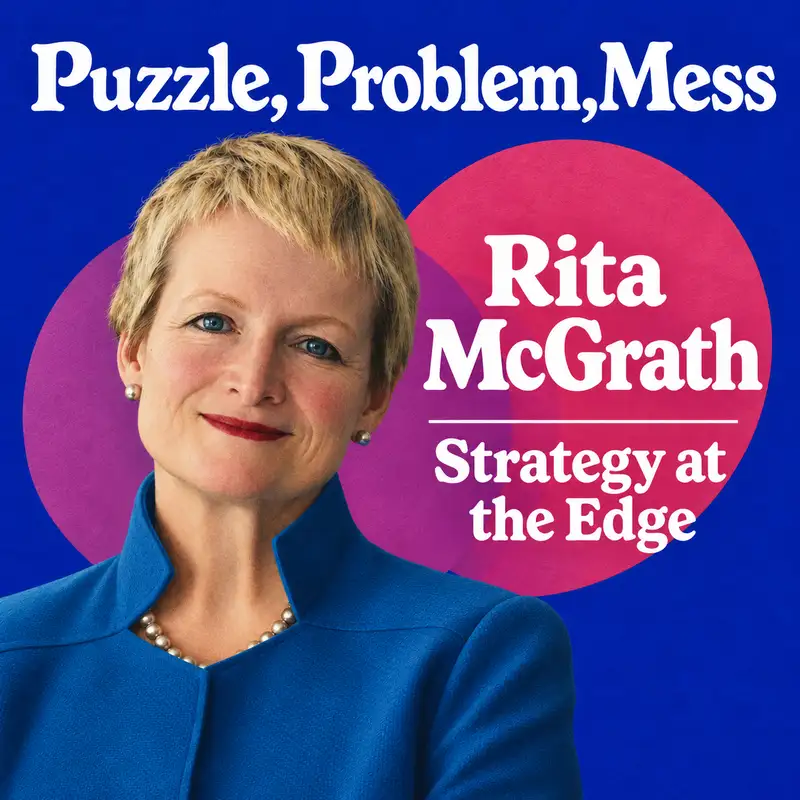
Strategy at the Edge - with Rita McGrath
The CEO can talk all day long, but if people don't believe it or don't trust it, it's never going to lead anywhere. I think really the front lines are the most important carriers of culture. Today, once you've got a center, the middle of the organization conceivably has a lot more latitude to act because that's where you're going to discover opportunities. That's where you're going discover what customers really need, how you connect the capabilities of the firm to the outside world. And I think the really great companies have always known this.
Rita McGrath:If you think about any company that you would hold up as having been tremendously successful, their middle managers and their leaders tend to be very connected to the outside world.
Dan Fahy:This is Puzzle, Problem, Mess. Looking ahead to the next media economy. One of the recurring themes of this podcast is that for a media company to remain competitive today, it's not merely a matter of strategy. It's also very much about how media companies can adapt their decades old structures, practices, and cultures, their identity in essence, to keep pace with the frenetic change afoot, which is why I'm thrilled to have been able to speak with Rita McGrath, one of the world's foremost thinkers on strategy, innovation, and organizational change. Rita is a professor at Columbia Business School, a best selling author, and has consistently been recognized among the world's leading management thinkers.
Dan Fahy:I came across Rita through her influential twenty thirteen book, The End of Competitive Advantage. Rita's book made the case that competitive advantages were becoming increasingly transient and that organizations needed to become much better at continually developing new competitive advantages and letting go of old ones. This strategic tension between old advantages and new competition has obvious parallels with the experience of today's media companies. And even the media disruptors of the last ten years are themselves needing to define new advantages and let go of old ones. We can see Rita's 2013 diagnosis writ large across the industry.
Dan Fahy:Fast forward to 2026, and Rita argues that we're living through a fundamental economic transition. And in this new environment, she argues, organizations need something that transcends the traditional definitions of their industries or businesses, what she calls a strategic center. In this conversation, we explore what that means in practice. It's a fascinating conversation about strategy, certainly, but also about how our media organizations and how the people within them, like you, can develop the confidence and capacity to act in the face of uncertainty. Here's Rita McGrath.
Dan Fahy:Rita, welcome to the podcast.
Rita McGrath:It's a pleasure to be here.
Dan Fahy:Rita, when you first wrote about Transient Advantage, the central thesis was that competitive advantages were becoming shorter lived and organizations needed to become much better at continually renewing them. Now your thinking's evolved more towards the concept of strategic centering, which you regard as an urgent task for today's enterprise businesses. Would you mind tracing a path for us from your breakthrough thinking around transient advantage in 2013 to your current thinking today?
Rita McGrath:Oh, sure. It actually starts even before that. So if I go all the way back to my very first book, which was called The Entrepreneurial Mindset, the core thesis of that book was that if advantages are indeed transient and we need to be continually renewing them and this is all the way back to the year 2000 then what are the models organizations might use to think that way? And what my co author and I hit on was the idea of habitual or serial entrepreneurs, so people that in their lifetimes have created multiple businesses over and over and over again. And so my very first book, The Entrepreneurial Mindset, was, well, how do you create an organization that can do that?
Rita McGrath:And then that led to a book called Market Busters, which was, well, where do you find opportunities? And then that led to Discovery Driven Growth, which is how do you make all this systematic? And then end of competitive advantage connected all that work, which is primarily about innovation and new discovery, to strategy. Then seeing Around Corners, which was the book after that, was really about, well, how do we think about these major inflection points in the environment that cause things to radically change, that cause the envelope of constraints, if you will, that we operate in? And then eventually, what I got to was, well, what we're in is not just a world where advantages are getting shorter, but the nature of what we're looking at in terms of economics has fundamentally changed.
Rita McGrath:So we're in the midst of a major transition from a world of mass production, making a million widgets of exactly the same thing, to a digitally infused world where we are creating the things that could be conceivably developed in units of one. And what we know about history is that these major sociotechnological shifts require shifting everything else, right? So shifts in institutions, shifts in how we think about what a job is, even. So I think the idea of strategic centering is when you're in a world that's not anchored to material things, how do you nonetheless create a center of gravity for your company, for your organization. And I call that a center.
Rita McGrath:And the idea is not so much a purpose, but more a here's what we're all about. And that opens up lots of opportunities. But it also tells us where we can make choices not to do certain things.
Dan Fahy:And I believe you're writing a book on this topic now. I am. And I think in the podcast that you had at the HBR Strategy Summit, I think you mentioned it's of the hardest things you've ever had to write. And I can sort of get a sense of why, but do you want to explain why it's so hard?
Rita McGrath:Sure. Well, it started out with an article that I wrote with Ram Sharan a couple of years ago on permissionless organizations. And the thesis of the article was, as advanced technologies get better and better, what they can do is substitute for what management used to do. So if you think about a typical manager in a large bureaucracy, a lot of their work is really around theoretically walking around with clipboards, asking people what the status of stuff is. And technology now is so good that a lot of that kind of work can be replaced by technology.
Rita McGrath:And what that means is if you've got clarity around what you're trying to do, small teams and even individuals can act independent of having to get permission from the organization. And so then that article was really well received. Everybody got very excited about it. And my editors came to me and said, Hey, would you like to write a book about permissionless organizations? And I thought, Oh, that's an interesting challenge.
Rita McGrath:Let me think about that. And this got me into this tailspin of, if you're writing a book about permissionless organizations, then inevitably you get to this thing where you have this dichotomy, Permissionless organizations do this and permissionless organizations do that. And I just could not get it to come together. And I literally spent years. I cannot tell you how many deletions accompany this work.
Rita McGrath:And what I finally realized was that this idea of permissionless is actually an outcome. It comes from having done the work to identify a center, really clearly articulate what you're all about. Once you've got clarity about that, then people can operate without permission because they know that they're advancing the center. But before you've got that clarity, the permissionless thing is just chaos. And if you think about many organizations that have tried to delayer or get rid of bureaucracy or whatever it is.
Rita McGrath:But if they're not clear about what's the scaffolding that replaces what bureaucracy used to do for you, it just degrades into chaos. A well known example would be Zappos, right? Which very famously decided to embrace holacracy was the term at the time. But they didn't replace the hierarchy and the bureaucracy with another kind of scaffolding. And so eventually, the thing just spun out of control and died of its and was sort of abandoned after many unsuccessful attempts.
Dan Fahy:Great. And I just want to return to that term you used before, of the digitally infused economy. When it comes to strategy formulation in this digitally infused economy, or as you've termed it, an age of structural uncertainty, you've observed that the strategy frameworks that most executives rely on were forged in what you've termed the stuff economy, where there were largely stable industry boundaries, well defined roles, corporate value resided in tangible things. But we're not in that age anymore, are we? I think you've written that we're at a major turning point, a sort of fifty year storm.
Dan Fahy:What's happening and what might we expect to see?
Rita McGrath:Well, a lot of this is going to depend on the choices that we make as a matter of policy and as a matter of organization and social design, really. So some of the things that happened after World War II let's just start there. What policymakers and people in business decided was that we were going to replace the the stable demand that was created by the war for business, with stable demand by creating a large middle class. And if you think about what happened in the 1930s, what we did as a society in the West, anyway was we created massive productive capacity. So beginning with the Ford and the assembly line, we just empowered our organizations to be so productive.
Rita McGrath:It was amazing. And yet, we didn't have the social structures that created a healthy middle class that could buy all that that productivity could create. So toward the end of World War II, policymakers and business people sat down and said, wait a minute. Once the war contracts are over, we really don't want to go back to the '30s. What we want to do is create a new kind of society.
Rita McGrath:And there was a tremendous amount of thought given to that. And if you think about it, this was all designed, the thirty year mortgage, which meant ordinary people could afford a home, the suburbs, which meant that land that had been previously not very valuable because it wasn't near a railroad station or a transport hub, all of a sudden, now you've got this land. If you provide access through cars, it can become valuable. People can buy a home. Once you've got a home, well, what do you need in it?
Rita McGrath:Well, you need a refrigerator, and you need dishwashers, and you need appliances. And then internationally, what The US and other Western countries decided was they looked at the end of World War I, and they said, wow, we really screwed up. We impoverished our enemies. We depleted their industrial capacity. We impoverished their people.
Rita McGrath:Therefore, they got really angry. And when they were able to revive their industry, they became very capable competitors. So let's not do that again. Let's do the Marshall Plan, which many people have described as the greatest bribe in the history of humanity. But what that meant was, for America anyway, stable demand for American industry because all of Europe was destroyed.
Rita McGrath:All of Japan was destroyed. So now you've got demand, right? And once business knows that it's got predictable demand, it can have the confidence to invest. So where are we now? Well, that whole construct worked very, very well for a long, long time for many, many people.
Rita McGrath:I'm not saying it was perfect by any means. I mean, was discriminatory. It was racist. It was like there were all kinds of bad things about it. But it did, for the first time in human history, lift a tremendous number of people into what we would today look at as a normal middle class life.
Rita McGrath:So the question then becomes, well, what do we replace that construct with for the coming world? And I would argue what we've got to think about is how do we do things that provide a good life for the majority of people, but a life that isn't so taxing on the environment. So this idea of digging stuff out of the ground, making something with it within a very short period of time, using it, and then throwing it in a landfill, that's probably not how we want to help people live their lives. So it's probably going to be much more digitally enabled. We're already seeing a shift to services as opposed to goods, digitally enabled transactions rather than just buying and selling, the move towards ecosystems rather than individual companies competing.
Rita McGrath:So we're starting to see early glimmers of this. But I would argue we need policy to keep up. And again, we're starting to see early signals of what this might look like. So things like social systems that can provide security for people who may not have regular forty year employment contracts with a company. So if you think about a company like TIAA in The United States, which is teachers insurance, it started out insuring for teachers.
Rita McGrath:And what they've moved to now is a mission around how do we provide secure retirement and annuity style income for people, even if they don't have a conventional job? Because a lot of what happened in the post World War II consensus was a lot of the social benefits were tied to employment. And what we're seeing now is the classic employment relationship. Of course, it's still there. But for many people, that's not their main way of making a living.
Rita McGrath:We're seeing gig workers. We're seeing creative workers. We're seeing social media influencers. You know? It's just not your job at General Motors the way it used to be.
Rita McGrath:Right? Yeah.
Dan Fahy:And I think you've written about this transition, the the defining characteristic of it is what you've termed dematerialization where as you've said value is shifting from physical stuff to digital stuff. And you write that when value dematerializes the old strategic anchors dissolve with it and it's that moment where companies need to find their strategic centre. But how should we understand what the strategic center is and what isn't it? What shouldn't we get it confused with?
Rita McGrath:Yeah, well, it's not purpose. And there was a huge flurry about purpose maybe two years ago. Everybody was saying, oh, purpose is the great unlock. And I think purpose is really important. What we know about human motivation, if you go back to the work of somebody like Dan Pink, is there's three things.
Rita McGrath:We need to feel mastery, a sense of growth. We need to feel control that we have some agency in what we're doing. And then we need to feel that we're connected to something larger than ourselves, which is purpose. And I think it's a very valuable concept. But I think centering is a little different than that.
Rita McGrath:Centering is really what gets you out of bed in the morning if you have an array of things you could do before lunch, which is the one that gets to the top of your agenda, which is the one that excites you, which is the one that at the core is sort of, wow, if I got that done today, I'd be really proud that I did that. And it's not necessarily purpose. So I identify five sort of archetypal centers, I'll call them. The first is a mission, which, again, different from purpose. And it's solving a particular kind of problem.
Rita McGrath:So I think a lot of times when people talk about purpose or mission or concepts like that, it gets very conflated with environmental goods or do gooding kind of stuff. I don't think it has to be that, but it does need to be a compelling problem. So that might be, how do I get a rocket to Mars? That might be, how do I solve very thorny medical problems? It might be, how do I pay for people's retirements?
Rita McGrath:So that's solving a particular problem. A second kind of centering is really focusing on a particular customer that you just want to serve so well that there's just no other alternative that they would even look at. And a canonical example there would be years ago. In The United States, we had a company called Southwest Airlines. And they were founded with the idea of making flying accessible to people who would otherwise drive.
Rita McGrath:And if you think about it, a drive, call it eight to ten hours in a car, well, if you put that in an airplane, that's a twenty minute flight. I mean, it's very short, right? Because airplanes can go a lot faster than cars. So if it's a really short flight, then all the other strategy choices you might make cascade onto that. So why do you care about assigned seats?
Rita McGrath:What you care about is just get on the plane and get off the plane as quickly as you can, right? Why do you mess with meals? You don't need it if it's only twenty minutes. Don't mess with people putting stuff in the overhead bins. Just give them free check bags, throw the bags in the belly of the plane, and on you go.
Rita McGrath:Everybody on the staff knows turnaround time at the airport is really important because if we're flying three times as many takeoffs and landing as any other airline, that turnaround time becomes a critical strategic thing. So that choice of a customer set to serve dictates everything else about the strategy. The third kind of centering is around technology or capability. And my canonical example there would be Fujifilm, which, if you think about it, faced the same existential threat that companies like Kodak faced when film chemical production of pictures became no longer necessary because we had such good digital replicas for it. And Fuji could have gone the same way.
Rita McGrath:Instead, what they did was say, Well, let's take a step back. Let's look at what we're good at, and let's then map that onto problems that the world needs to have solved. But they started with the technology and the capability, and then they went and looked at what customer needs are. So a fascinating case of that to me is collagen. So if you think about color film, a really important chemical that goes into color film is collagen.
Rita McGrath:It sticks everything together. And you don't want your pictures to fade, so you need to really give some serious thought to oxidation, which causes pictures to lose their color. Well, if you think about it, human skin has a tremendous amount of collagen in it. That's what keeps us all stuck together. And oxidation is what gives you wrinkles and other unpleasant things.
Rita McGrath:And Fuji for sixty years had been good at collagen and deoxidation in the pursuit of film. And so they said, Well, hang on. That's valuable in cosmetics. Why don't we go into cosmetics? Which they did.
Rita McGrath:And it makes no sense at all if you look at it through a traditional strategy lens. You're a film company and now you're in skincare. But it makes perfect sense if you look at it from a centering technology. The fourth kind of centering is what I call friction reduction, which is how do I get rid of things that are just unnecessarily hard? Red tape or barriers or something that causes a customer not to be able to get what they need to get done, done.
Rita McGrath:How do I eliminate that? And a great example of this would be a company like Penske, which is a large trucking company in The US. And their core business model is they will buy trucks. They will then lease them to their customers, who are retailers and people that ship food around and stuff like that. Those people don't care about trucking.
Rita McGrath:What they want is the truck to be up and to work and for it to be available. And what Penske does is assure them that that will happen. And so they remove that whole friction of maintaining and looking after trucks so that the customers can get on with what they want to. And then the last kind of centering is around an ecosystem or a region. And that involves working with lots of partners.
Rita McGrath:So many companies have actually benefited from this ecosystem thinking. So if you go all the way back to Sony in its early years, so what they wanted to do, Morita, who is one of their founders, he wanted to make Japan synonymous with quality. Because when he first started the company, it wasn't. It was if you wanted cheap, throwaway goods, you bought them from Japanese companies. And he said, no, no, no.
Rita McGrath:We want to be known for quality. And that tied Sony's fortunes to the fortunes of many Japanese companies. And that's an example of thinking like an ecosystem or a regional ecosystem.
Dan Fahy:Yeah, fascinating. And thank you for bringing up the Fujifilm example. And you also write about Novartis and these examples, it seems like the companies that have managed to center themselves, as you say, have also managed to somehow pry their fingers off their old identity and you went through arena thinking. But that's presumably very difficult because the old category bestowed careers, power, status identities. When you've looked at these companies, how have they managed to shake off the trappings of their old identity and move to something that's not what they used to be?
Rita McGrath:I would say the difference between those that have managed to do it well and those that haven't is the ones that have done it well have been very intentional about it. So I'll go back to Novartis. Were when Vosneros somehow came in as CEO, they were a typical pharma type company at the time. They had a pharma brand, scientifically based patented medicines. But they also had eye care, they had over the counter medicines and they had generics.
Rita McGrath:They had this whole grab bag of stuff. And the strategy theory at the time was when your medicines went over a patent cliff, that what would rescue you would be your nice, safe consumer products, that kind of thing. And Wassner Sindheim went back and looked at the history. And he said, actually, I don't think that theory holds. What saved us every time was the next wave of really ingenious medicines.
Rita McGrath:And so he made a decision to really center the company on this mission, innovative medicines that do what could not be done before. And they literally call it reimagining medicine in their tagline. And then he realized that if he was going to do that, that the culture of the company would have to change. And so they started a massive effort on culture change. And they decided to adopt three core cultural principles.
Rita McGrath:And based on Dan Pink's work, actually, which we brought up earlier. And so their cultural touch phrases were, we want to be inspired. So that's the century, right? We're inspired by what we can do for patients. We want to be curious because we want to continually be open to new discoveries.
Rita McGrath:And we want to be, I love this phrase, unbossed, which caused, as you can imagine, enormous amounts of controversy in because the it's not a very well defined term. And so a lot of people are like, what do you mean unbossed? Do mean I get to do whatever I want? No, and that's not the idea at all. The idea is unbossed, but not unled.
Rita McGrath:Unbossed means taking initiative, owning your work, being accountable, being up here with your colleagues, moving forward in this pursuit of innovative medicines. But it doesn't mean you get to do whatever you want. It doesn't mean you have no accountability. And so there was a lot of disagreement. So they, together with this structural stuff with this, so it's the spin offs and the sell offs and everything, a huge investment in culture.
Rita McGrath:And their head of HR really led that at the time. And now it's being carried forward by their current head of HR named Rob Kowalski, who is just chief by jail with Narasimhan on the human side. They call it people in operations. On the culture side, how do we make this a living, breathing reality? And just to give you an example of a very subtle thing, but I think it matters.
Rita McGrath:When Novartis started on this journey, it was a very typical Swiss based, European based company. Everybody wore suits and ties and skirts and high heels and all that stuff. And Vas basically said, Hey, we're going get rid of that. Come to work however you feel. I mean, clothes, but come to work dressed in however you think you can contribute the most to your own advancement and productivity and the purpose of our company, the center of our company.
Rita McGrath:And so he would come to work in jeans. And it was a small thing, but I think it sent a symbol to the company that we're not going to judge you on how you look or where you are in the hierarchy or how big your limo is or any of that stuff. We're going to judge you on what it is you're able to accomplish.
Dan Fahy:Fascinating. And then staying with that topic of culture, before researching this conversation, my perhaps simplistic instinct was that you needed that C level leadership culture, which you've sort of said there at Novartis, know, it was the CEO and the leader of HR and it was a very intense program of culture change. But I think you've also written that it's not essential to have that to get culture and you can bring about culture change through more incentives, decision making, some more tactical operating. Do you mind talking a little bit about about that? How you can how a company or you've seen companies accelerate a culture change, not necessarily just from the top, but sort of from the middle of the organization?
Rita McGrath:Oh, I think it's key. I mean, that's really where culture lives, right? I mean, the CEO can talk all day long, but if people don't believe it or don't trust it, it's never going to lead anywhere. I think really the front lines are the most important carriers of culture. And I think the most powerful lever is incentives.
Rita McGrath:And people always think of money when I talk about corporate incentives. And sure, money matters. I mean, if you don't have enough money to pay the bills, you're not going to be a good employee because you're worried all the time. And you've got half your brain thinking about where's dinner coming from. So you have to have that basic level of whatever.
Rita McGrath:But once you get beyond a certain level of basic comfort, money is very limited in its ability to change behavior. So I think what we want to think about is things like how visible are the incentives? How notable are they? How effectively can they be used? Do I trust that if I take a certain action that that behavior will result in a reward?
Rita McGrath:I think there's a lot of things you can think about in terms of how you design the system around it. So I have a framework that I use for thinking about organizational alignment. And I call it kite. And the reason I like the kite as a metaphor is that you can't force a kite to fly. You can yell at it.
Rita McGrath:You can stamp your feet. You can issue edicts. But if you don't launch it into the right circumstances, if you don't build it in balance, it's just going to lie there. And so the elements that I look at are, the first is agenda, which is quite literally what's the organization spending its time on. So what's on the agenda and what's not?
Rita McGrath:The second is, I call them norms. You can think of that as the cultural dimension. So what do we take for granted as the way we do things around here? And every organization's got different cultures. After my son graduated from college, he went to work for Accenture, the big consultancy.
Rita McGrath:And it was a Sunday night, and we were getting ready to go to dinner to celebrate something. But it happened to be the last day of the month. And so we've all getting ready to go out. We've got our coats on, everything. And he says, oh, wait a minute.
Rita McGrath:I can't go yet. I need about twenty minutes before I can leave. And I said, what? He said, I've to submit my time and expense reports. And I said, oh, come on, do that tomorrow.
Rita McGrath:And he looked at me, his eyes as big as saucers. And he says, mom, there could be floods. There could be earthquakes. I could have bubonic plague. But time and expense reports go in on time.
Rita McGrath:And this is the last day of the month, and they're due. I thought to myself, my goodness, this company has accomplished in about two months what, in twenty four years of patient mothering, I have never been able to achieve. So that's norms, right? I mean, that's a norm, you don't mess with it. Then you've got what I call news, which is what data do we collect?
Rita McGrath:What story do we tell about it? And then how do we communicate what that means? And again, different cultures will prioritize different kinds of news. If you're in a really financially oriented company and I remember this. I went into the offices of Honeywell years and years ago.
Rita McGrath:And you literally went into their headquarters. There's the receptionist there to meet you. And above her desk was a stock ticker symbol. This was in the Larry Bossity era, so it goes back a ways. But you knew what news that company was paying attention to right from the minute you walked in the door.
Rita McGrath:Then you can think of the spine of the knight as your people, your formal and informal structures. So who's with who, who reports to who, whatever. At the next pole of it, you've got the allocations, which are what do you spend your budget on? What do you reward? Things get rewarded, what things don't.
Rita McGrath:So the whole allocation of resources. You can think of the tail of the kite as your history. And what I like about that metaphor is a kite with no tail all over the place, right? This is one of the challenges startups have, which is they don't have that history to rely on. But a history that's too heavy, that holds you back too much, never going to get in the air.
Rita McGrath:And then the leadership element to me is like the string of the kite. I like it as a metaphor because you can guide it. You influence where it goes, but you can't control it. And if you so jerk around, it's as likely to come crashing down as it is to go in the direction that you desire. So that's the leadership element.
Rita McGrath:So what I try to think about is those things all in a coherent whole. And so depending on your center, your kite's going to look very different. So if you're Novartis and you're centered on innovative medicines, well, your allocations of resources are going to be much more around that than if you're, say, Penske and you're centered on solving frictions where you're really going to spend money on the front lines and the tools are all going to be absolutely gorgeous. There's a way to do things in a way you don't do things. And it's a very different kind of setup than you would have with a different centering.
Dan Fahy:I can see why you had to wrestle for so long with this notion of the permissionless organisation because it really does all link back to that centre, doesn't it, all those pieces. Final question, and maybe it relates to a concept I heard you refer to, there's this notion of the span of control, but I think you're sort of starting to replace that reference with span of connections now in organizations. But I wanted to talk about the middle of the organization because that's a topic that I'm particularly interested in. Personally, I see enormous latent capability in the middle of media organization, but it's often underdeveloped or underestimated or treated primarily as an administrative layer. But what do you see is the future of the middle of the organization in these more adaptive, permissionless organizations that you're envisaging?
Rita McGrath:I think the potential for the middle of the organization is enormous. And the reason I say that is I see the unit of value creation as being actually teams and even individual people. So if you think about what the middle of the organization did in a classic industrial company, you had strategy coming at you from wherever it was created. And then your job was execution and managing the front lines and more about efficiency and that kind of thing. Today, once you've got a center, the middle of the organization conceivably has a lot more latitude to act than they would have had in a more traditionally controlled bureaucracy because that's where you're going to discover opportunities.
Rita McGrath:That's where you're going discover what customers really need, how you connect the capabilities of the firm to the outside world. And I think the really great companies have always known this. If you think about any company that you would hold up as having been tremendously successful, their middle managers and their leaders tend to be very connected to the outside world. They're constantly in conversation with customers. They're listening in on the call centers.
Rita McGrath:They're spending time at what I call the edges. And I think that's where people in the middle layers are going to add a lot of value. I would also argue the middle layers are going to be what would I say? If an organization can make do with far fewer layers of bureaucracy, what that means is the actual point of action is going to be in those middle layers. You're going to not see that many people at the cooktop.
Rita McGrath:You're going to see a lot more people at that sort of activity layer in the middle.
Dan Fahy:That's Maddie. Rita, one of the questions I always ask my guests is what advice they'd have for people who are starting their careers or who are midway through their careers in the middle of the organization. Given the future we can sort of see approaching so fast, what would your advice be to people in starting out or in the middle of the organization?
Rita McGrath:I think that you should build resilience around the things that you can control. So a couple of very specific pointers. One, find one or more mentors. Glue yourself to those people. Learn what they do.
Rita McGrath:Learn how they've been successful. So think about it. Let's say you're a 20 person and you're just thinking about your career. Find someone who's doing things that you think, wow, if I could do something like that, that would be amazing. And go find a couple of those folks and learn from them.
Rita McGrath:Make yourself useful. By the way, be helpful in that. And I would also say most of those kind of people, the people that you would admire, if you come at it the right way, are more than happy to help. If they're successful, if they're at a stage of their career where they've overcome a lot of challenges, they're often very willing to pass on their knowledge and their understanding. So find a mentor, find a sponsor, find somebody who will advocate for you when you're not in the room.
Rita McGrath:Next is find a cohort. So what you want is a group of, call it, 10 to 15 people who are perhaps peers who you get together with on a regular basis. And be intentional about that. And be intentional about each other doing that. Because what you'll find is the organization that you're affiliated with at any particular time may come, may go, may whatever.
Rita McGrath:But the network that you build of people that you've picked out as people that could be useful to you, that can endure. And that can endure no matter where you're working or what you're doing or what life stage you happen to be in. So find a sponsor, find a mentor, build that peer network. And then when it comes to things like what do I invest in in terms of study, I would say invest in fields where you're learning the skills that no AI is going to replace. So resilience, creativity, the ability to detect patterns, the ability to make sense of things.
Rita McGrath:And then what's uniquely human, right? The ability to tell stories, the ability to be different, the ability to do things that are not average. Because AI averages everything up. And what I worry about with a lot of companies is everything's starting to sound the same. I don't know about you, but I read a lot and I'm starting to see the same sentences all popping over the place.
Rita McGrath:It's just like, wait, did AI write this right? And so I think what you want to do is hone those abilities that are not going to be replaced by any kind of AI and really focus on those.
Dan Fahy:It's fascinating. Almost like the notion of the organizational strategic centering distilled down to the person. It's sort of you've got to have a center that can traverse whatever industry or career you end up
Rita McGrath:I think so.
Dan Fahy:Cycling through.
Rita McGrath:I think that's absolutely right. And I think it's also important to connect to what you're really excited about. I I look at generations of young people who are told, oh, go learn to code. Remember that? Go do something useful.
Rita McGrath:Don't study humanities and what's practical. And what are they all being told now? Oh, go study the humanities because the AI is going to code better than anything that ever will. A reversal, right?
Dan Fahy:Exactly. Fantastic. Rita, thank you so much for this conversation in... Enormous amount in there, and, really appreciative of your time this morning.
Rita McGrath:Oh, it's a pleasure to chat to you.
Dan Fahy:That was Rita McGrath. And there's links to Rita's work and current thinking in the show notes. So please do check those out. Thanks for listening. I'm Dan Fahy.
Dan Fahy:Original music by Lee Roseveer and So Cal. And if you like this episode, please pass it on to a friend or colleague.